

Ghosts of the Green State: 10 Most Haunted Places in Vermont
When it comes to the most haunted places in Vermont, the Green Mountain State is loaded. Whether you’re hiking trails or peeking into colonial taverns, Vermont’s history is ready to give you chills.
These are the 11 most haunted places in Vermont:
Emily’s Bridge
Stowe

Emily’s Bridge, officially known as Gold Brook Covered Bridge, is home to one of Vermont’s most famous ghost stories.
The legend has two versions: In one, Emily fell in love with a man whose wealthy family refused to accept her. The couple planned to elope, and she waited for him at the bridge at midnight. He never came, and in despair she committed suicide by hanging herself from the rafters.
In the other version, Emily prepared to marry the man she loved but he failed to arrive on their wedding day. Pissed and heartbroken, she drove her horse and carriage to confront him, but lost control at the bridge and crashed, killing herself and the horses.
Over the years, people crossing the bridge have had strange encounters.
Visitors describe hearing screams and feeling scratches on their skin. Cars and horses have left the bridge with unexplained marks. Some see flashes of light, shadowy figures, or blurry orbs in photographs.
The Equinox Hotel
Manchester

The Equinox Hotel has stood in Manchester since 1769 and has welcomed U.S. presidents including Ulysses S. Grant, Theodore Roosevelt, William Howard Taft, Benjamin Harrison and more.
Its most famous resident, however, is the ghost of Mary Todd Lincoln. She first visited in the summer of 1864 and made plans to return with her husband. A special suite was even prepared for President Lincoln, but he was assassinated before the trip could happen.
Guests and staff believe Mary Todd Lincoln still roams the halls of the Equinox.
People report seeing her apparition, sometimes with a small child by her side. Others have felt cold chills, heard whispers, or noticed objects moving on their own. Lights have turned on in empty rooms, startling guests awake in the middle of the night.
The Equinox Hotel leaves visitors wondering if Mary Todd Lincoln continues to visit the place she once loved so much.
The Eddy House
Chittenden

In the 1870s, the Eddy House in Chittenden became the focus of national attention.
William, Horatio, and Mary Eddy, lived in the rundown farmhouse that became known as one of the strangest sites in America. Newspapers and Spiritualist accounts described the house as a place where the supernatural ran unchecked.
People traveled from around the world to witness the bizarre events, leading Spiritualists to call Chittenden the “Spirit Capital of the Universe.”
The Eddy family came from a long line of psychics and seers. Their father, Zepaniah, sold William and Horatio into a traveling show where they were forced to perform demonstrations of their unusual abilities.
As children, the Eddy siblings were surrounded by strange events. Objects around them would lift into the air on their own, sometimes sailing across the room without warning. Furniture scraped against the floor on its own, and dishes or books would tumble from shelves with no one nearby.
These unexplained disturbances made school impossible, as teachers and classmates grew wary of the bizarre activity that seemed to follow the children wherever they went.
After Zepaniah’s death, the brothers returned to Chittenden and began hosting séances at the house.
The Spirit Cabinet
Their most famous performance involved a “spirit cabinet.” The cabinet was a wooden box or small enclosed booth, often about the size of a closet, with a chair inside and curtains drawn across the front.
During séances, William Eddy would sit inside the cabinet while the participants waited in a darkened room. Once he was concealed, the curtains would rustle and figures said to be spirits would emerge into the circle, sometimes appearing in full form, other times only as disembodied hands or faces. The cabinet was meant to serve as a physical gateway between the living and the spirit world, creating both an air of mystery and a controlled space for the apparitions to appear.
Even after the séances ended, reports describe voices echoing in empty rooms, the walls shaking without cause, and a heaviness that overwhelms visitors.
Whether genuine or not, the Eddy House remains one of the most haunted places in Vermont.
Did you know?
Today, the Eddy House in Chittenden, Vermont, is a private lodge, known as the HighLife Ski Club.
Lake Bomoseen
Castleton
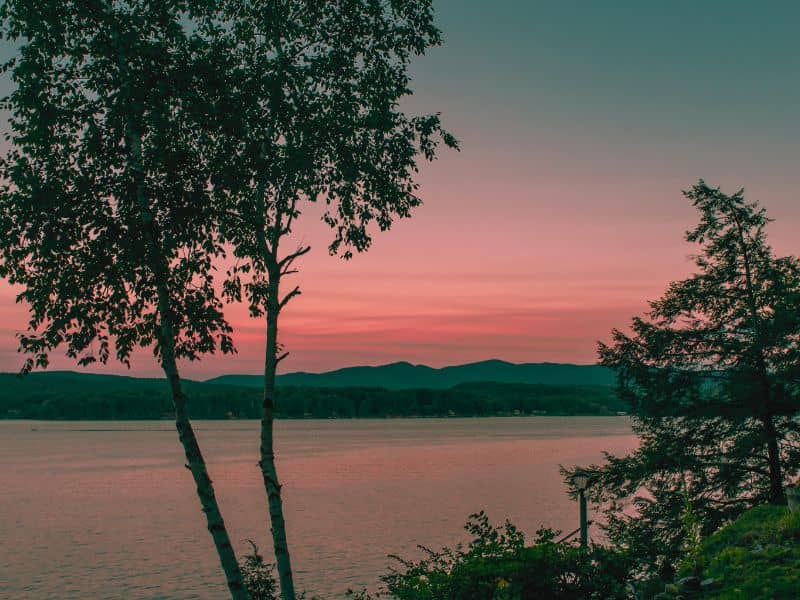
Lake Bomoseen carries a haunting story that dates back to the 19th century.
At the time, the town thrived with mills and slate quarries. But with prosperity came danger, and tragedy struck when three Irish quarry workers spent an evening drinking at a lakeside tavern. On their way home, they set out in a rowboat across the lake. The boat was later found empty, but the men were never seen again.
Soon after, people began reporting seeing a rowboat gliding silently across the moonlit waters. The vessel appears empty, yet the oars move without making a splash.
To this day, the ghostly boat is said to drift across Lake Bomoseen, a reminder of the quarry workers’ final journey.
The area itself has an industrial past.. In 1852, the West Castleton Slate Company built an entire village around the lake, fueled by rare green and purple slate. The village was named West Castleton, after the company.
After the 1929 stock market crash, the company collapsed, and the village was abandoned. Visitors walking the Bomoseen Slate History Trail can still see remnants of homes and mills.
The Norwich Inn
Norwich
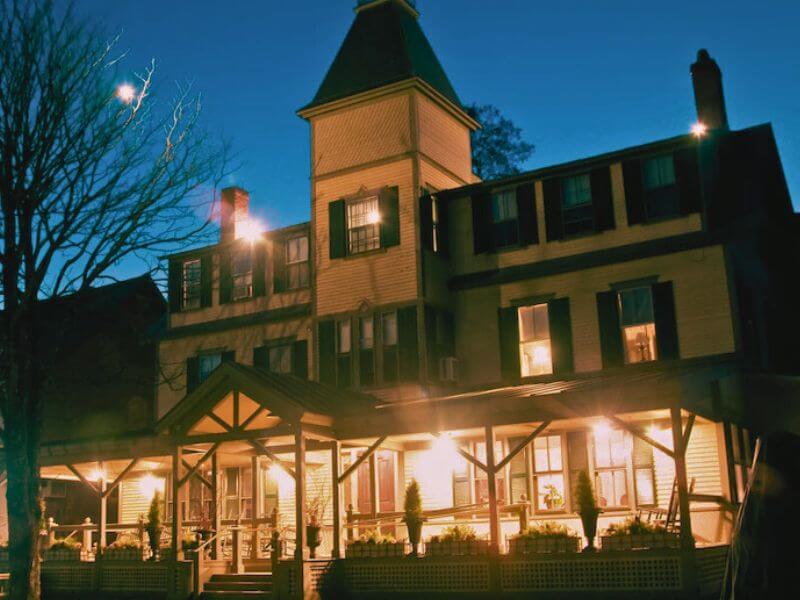
The Norwich Inn has been welcoming travelers since 1797, but its most famous guest never checked out.
In 1920, Charles and Mary “Ma” Walker purchased the inn. During Prohibition, Ma kept the tavern lit by selling illegal liquor from the basement. There are rumors that Theodor Seuss Geisel (better known as Dr. Seuss) may have been a customer of hers.
Over time, her presence became legendary.
Staff and visitors describe seeing a woman in a long black gown drifting through the parlor before vanishing into the library. Room 20 is especially active, with guests reporting strange sounds and objects moving on their own. Taps have been known to turn on without warning, and one guest claimed a spilled water glass ended up full again, tucked neatly under the bed.
To this day, patrons of Jasper Murdock’s Alehouse sometimes see the figure of Ma Walker.
The Bennington Battle Monument
Bennington
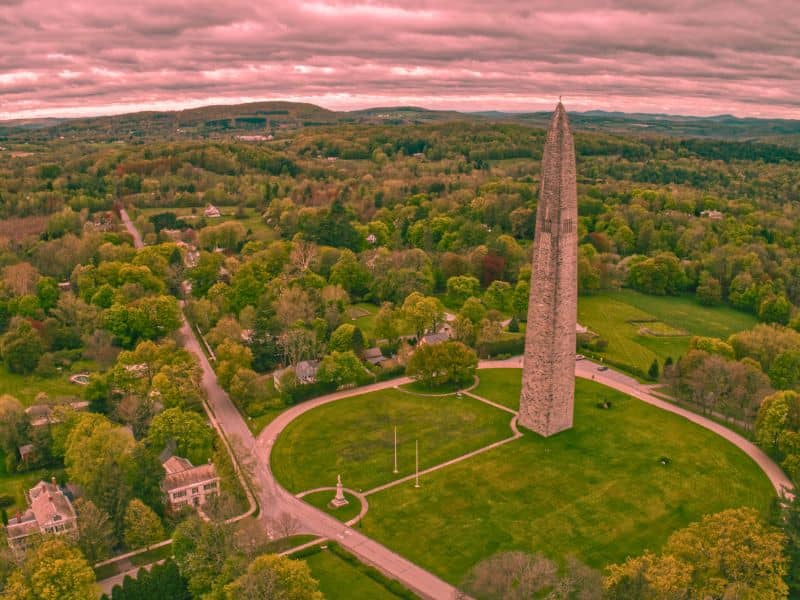
Rising 306 feet above the town, the Bennington Battle Monument honors a Revolutionary War victory that took place in August 1777.
The battle was a turning point for American forces, who defeated a larger Hessian and British detachment sent to capture supplies. The monument, completed in 1891, commemorates the soldiers who fought and died there.
Visitors have reported cold spots at the base of the monument, especially at night, along with shadowy figures pacing the grounds. Others claim to hear musket fire and battle cries drifting through the air, long after the battlefield fell silent. On certain anniversaries of the battle, the phenomena intensify, with some guests describing the smell of gunpowder or the sensation of being surrounded by an unseen crowd.
A Revolutionary War soldier in uniform has been spotted near the monument, endlessly pacing.
Did you know?
You can take guided tours of the monument.
Green Mount Cemetery
Montpelier

Founded in 1854, Green Mount Cemetery covers 35 acres of Montpelier’s hillside. At night, it has earned a reputation as one of the most haunted places in Vermont.
Visitors describe orbs floating over graves, phantom footsteps following joggers, and the unsettling feeling of being watched. Low voices sometimes murmur through the air, and glowing red eyes have been spotted staring over headstones.
One of the cemetery’s most infamous features is the bronze statue commissioned by businessman John E. Hubbard, who was buried there in 1899.
Locals nicknamed the hooded figure “Black Agnes,” though its true title is “Thanatos,” the Greek word for death.
People say sitting on the statue’s lap can bring bad luck, sickness, or even death; a curse tied to Hubbard’s stingy reputation.
Beyond the statue, visitors have seen ghostly children playing among the graves between 10 p.m. and 4 a.m., and a tall shadow figure drifts through the cemetery, leaving those who encounter it suddenly overwhelmed with sadness. Once the shadow is gone, the heaviness lifts.
The Shelburne Museum
Shelburne

The Shelburne Museum is one of the most haunted places in Vermont, thanks to the Dutton House.
Originally built in Cavendish in 1782 by Salmon Dutton, the house has worn many hats over the years. It has been a family residence, a tavern, an inn, a boarding house, a store, and office space.
By the early 1900s, more than 11 people had died inside its walls, and the building was left abandoned until it was moved to the museum grounds in 1950.
Records list the following family members who died in the Dutton House, though most of the causes of death remain unknown:
- Salmon Dutton Jr. (1785–1850): the son of the original builder.
- Salmon Dutton Sr. (1744–1824): the house’s founder, who lived there until his death.
- Sarah Dutton (1751–1833): Salmon Sr.’s wife.
- Mary Dutton (1779–1861): one of their daughters.
- Edward Dutton (1787–1822): another of their children who died young.
- Elias Dutton (1789–1871): a family member tied to the property for decades.
- Lucy Dutton (1791–1839): a daughter who passed away in middle age.
- Abigail Dutton (1780–1854): another member of the household.
- Charles Dutton (1797–1843): who carried on the family name.
- Harriet Dutton (1799–1874): another daughter who lived her entire life connected to the property.
- An unnamed infant Dutton (early 1800s): one of many Dutton children who died as babies.
From the outside, the house looks like a beautiful New England colonial, but the atmosphere changes once you step through the door.
Staff members and visitors have described an elderly man with a scruffy face crouched in the attic or strolling through the rooms. Some have also heard the sounds of a little girl crying, and a few claim to feel as though both the man and child are following them during tours.
The Dorset Inn
Dorset

Dorset is your quintessential Vermont village, complete with a green, small shops, and historic inns.
As one of the most haunted places in Vermont, the Dorset Inn stands out. Built in 1796, it has welcomed travelers heading to Boston, Albany, and beyond.
Guests often stay for weeks, enjoying Vermont’s scenic countryside, fine cuisine, and outdoor adventures. The inn features thirty-five guest rooms, several of which are part of the original structure, and its dining room has been recognized as one of America’s finest.
The Dorset Inn is also home to a persistent ghost known as “The General.” Staff and guests report seeing him dressed in a dark military uniform with gold braid, reminiscent of the Civil War.
Most sightings occur in the taproom, but he has been spotted on the third floor. Sometimes, he appears with a woman in an old-fashioned long skirt and a child. His identity remains a mystery, but his presence endures, quietly observing the inn.
The Hartness House Inn
Springfield
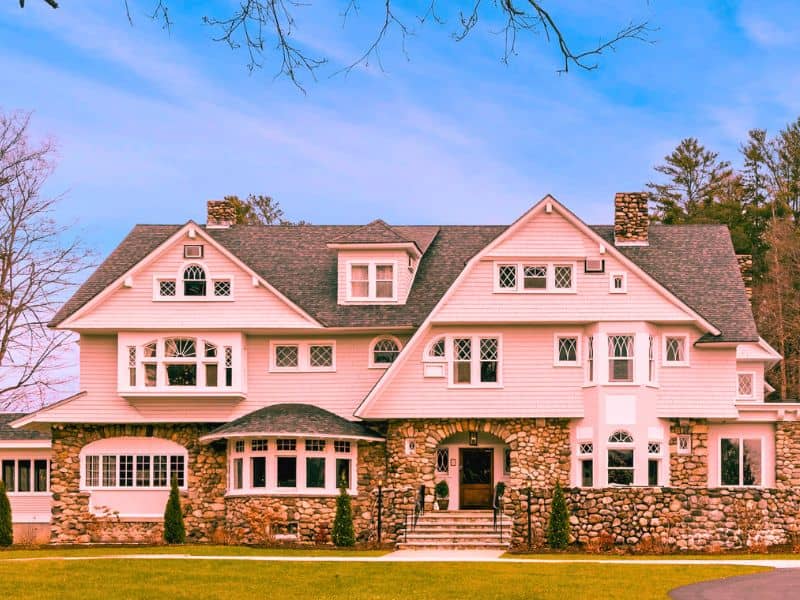
The Hartness House Inn, a historic estate built in 1904 by James Hartness, inventor, industrialist, and Vermont governor, also features an antique observatory complete with a working 1910 equatorial tracking telescope.
Now an elegant inn on 35 acres of countryside, it is considered one of the most haunted places in Vermont.
The property contains secret underground tunnels and rooms that Hartness used as private workspaces, including a library, workshop, study, and lounge. These spaces are the center of many paranormal reports. Guests have seen objects disappear and reappear, electricity turning off mysteriously, and unexplained movements throughout the tunnels.
Some believe the inn is haunted by Hartness himself, whose energy remains in the estate. Another resident ghost is a young boy named Charlie, associated with the corner room where Charles Lindbergh once stayed.
Visitors and staff report unusual occurrences in both the tunnels and guest rooms, including flickering lights, sudden drops in temperature, and objects that seem to move on their own.
Guests staying overnight have heard unexplained footsteps in empty hallways, while others describe feeling watched in certain rooms. In the tunnels, people often experience disembodied voices, missing items that later reappear, and strange electrical malfunctions.
Haunt Us
Don’t let your ghost stories go untold. Have you been to any of the most haunted places in Vermont? Share your ghost-hunting experiences in the comments below, visit the forums, and become part of our haunted community.


