Witch Way to Go? 10 Most Haunted Places in Massachusetts
You’ve just discovered the most haunted places in Massachusetts, where colonial ghosts, witchy whispers, and tragic tales haunt every cobblestone!
These are the 13 most haunted places in Massachusetts:
Lizzie Borden House
Fall River

The Lizzie Borden House is one of the most haunted places in Massachusetts, and for good reason. On a hot August morning in 1892, something unthinkable happened here.
Andrew and Abby Borden were evilly hacked to death in broad daylight—Abby upstairs while she was cleaning and Andrew downstairs as he napped. Both were struck multiple times with a hatchet, yet no one outside heard a thing.
The prime suspect? Their daughter, Lizzie Borden.
Lizzie’s trial shocked the nation. Despite the horrific nature of the murders and suspicious behavior, like burning a dress shortly after the crime, Lizzie was acquitted. To this day, no one else has been charged.
Now a bed-and-breakfast, visitors can stay overnight in the same rooms where the murders took place. Many report paranormal activity: the sounds of footsteps in empty hallways, objects moving on their own, and strange cold spots that appear out of nowhere.
Some claim to hear faint voices or feel an unsettling presence, especially near the spot where Andrew Borden was found. This house has seen unimaginable horrors and is far from at rest.
The Bridgewater Triangle
Southeastern Massachusetts

The Bridgewater Triangle is a 200-square-mile region in Southeastern Massachusetts known for countless paranormal occurrences.
This zone includes towns like Abington, Rehoboth, and Freetown and is infamous for ghost sightings, UFOs, and other strange phenomena.
At the heart of the triangle is the Hockomock Swamp, where people report Bigfoot sightings, glowing orbs, and giant, pterodactyl-like birds. The Freetown-Fall River State Forest is said to be the hiding place of cult activity, animal mutilations, and mischievous creatures from Native American folklore called Pukwudgies.
The area’s dark history, from murders to Native American curses, makes it one of the most haunted places in Massachusetts.
Paranormal Phenomena in the Bridgewater Triangle:
- Ghost sightings: Ghosts and shadowy figures appear throughout the region, especially in Taunton State Hospital and the historic Hornbine School.
- Unnatural animals: People have reported seeing out-of-place animals like black panthers and giant snakes, as well as enormous, aggressive dogs.
- Thunderbird sightings: Witnesses have described enormous birds with wingspans of up to 12 feet, often seen flying over Hockomock Swamp.
- Bigfoot: Sightings of huge, hairy humanoid creatures have been reported, particularly in the swamp.
- Pukwudgies: These small, malevolent beings are said to lure people into dangerous situations.
- Cult activity: Freetown-Fall River State Forest has been the site of cult rituals, including animal sacrifices, murder, and satanic practices.
Fact:
The Lizzie Borden House falls within the Bridgewater Triangle.
Salem Witch House
Salem

The Salem Witch House, also known as the Jonathan Corwin House, is deeply linked to the Salem Witch Trials of 1692. Though not used for the trials, it was the home of Judge Jonathan Corwin, who signed many of the arrest warrants that led to the executions.
Visitors have sensations of being watched, cold spots, and full-bodied apparitions. In line with the superstitions of the time, a black shoe was found inside the walls to ward off witches, and a poppet (a doll used in witchcraft to cast curses) was discovered nearby.
This poppet is associated with Bridget Bishop because it was believed she used them to harm her victims.
Judge John Hathorne: The Hanging Judge
Another person associated with the Witch House is Judge John Hathorne, known as “the hanging judge.” Hathorne, a close friend of Jonathan Corwin, played a leading role in the Salem Witch Trials and sentenced many to death.
His heartless treatment of the accused made him one of the most hated and feared figures of his time. His spirit is said to haunt the Old Burying Point Cemetery, just steps from the Witch House.
The Corwin Curse
Judge Jonathan Corwin, the house’s owner, was another evil figure in the Salem Witch Trials.
By 1718, 8 members of the Corwin family had died prematurely, leading to rumors of a curse tied to the family’s involvement in the witch trials. This has been called The Corwin Curse.
Visitors today still feel the eerie presence of the Corwins and the victims of the witch trials, making The Salem Witch House one of the most haunted places in Massachusetts.
The Joshua Ward House
Salem
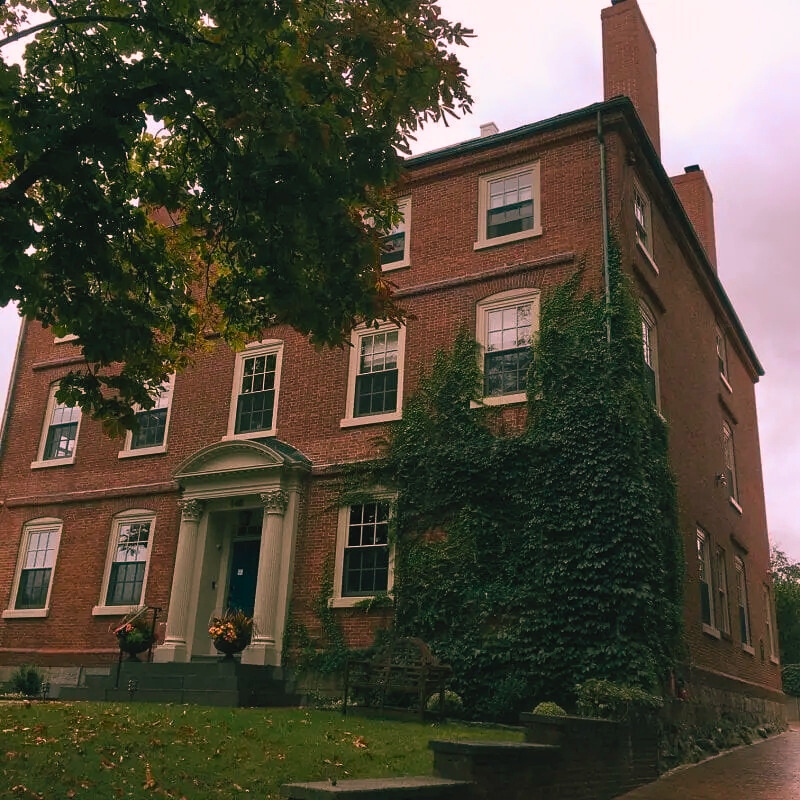
The Joshua Ward House also has dark ties to the Salem Witch Trials. The house was built in 1784 for sea merchant Joshua Ward and is known for its connection to High Sheriff George Corwin, nephew of Judge Johnathon Corwin of the Salem Witch House.
- George Corwin: The Strangler: At 25, George Corwin became High Sheriff of Essex County, responsible for carrying out the hangings of accused witches, including Sarah Good and Rebecca Nurse. Corwin gained a reputation for his cruel methods, especially in the execution of Giles Corey, who was pressed to death under Corwin’s orders. His ghost lingers in the house, and people have felt an invisible force choking them.
- The Curse of Sarah Good: Sarah Good was a young woman who was executed after refusing to confess to witchcraft. Before her death, she cursed her accusers, famously telling Reverend Noyes, “God will give you blood to drink.”
- Years later, Noyes died choking on his own blood, fueling the belief that Sarah’s curse came true.
- Giles Corey: The Angry Man: Giles Corey, accused of being a warlock, was tortured by Corwin in a brutal process where heavy stones were placed on his chest. His last words, “More weight,” echo his defiance, and his pissed off spirit is believed to haunt the house. Books flying off shelves, cold spots, and candles melting into strange shapes are all attributed to Corey’s restless ghost.
- The Ghost of a Witch: A mysterious female spirit, thought to be one of the witches executed under Corwin’s orders, appears on the upper floors. This ghost gained fame when a Polaroid photo taken in the 1980s captured her eerie image during a holiday party.
The Samuel Pickman House
Salem

The Samuel Pickman House, built in 1665, is a well-preserved Colonial-style home located at 43 Charter Street. It’s part of the Charter Street Historic District, which also includes the Salem Witch Trial Memorial, built behind the house in 1992 to honor those executed.
The house is also steeped in darkness. According to local folklore, Samuel Pickman descended into madness, chaining his daughter in the attic, where she starved to death. He later poured boiling wax over his wife before hanging himself.
Visitors have reported seeing a young girl staring out from the second-floor window, hearing creepy childlike voices, and capturing mysterious orbs and faces in photographs. These haunting tales make the Pickman House one of the most haunted places in Massachusetts.
Fact:
In the early 19th century, François Corne, a resident of the house, helped disprove the myth that tomatoes were poisonous by eating them without ill effects.
The Houghton Mansion
North Adams

The Houghton Mansion in North Adams was built in 1890 by A.C. Houghton, the town’s first mayor. The mansion is now home to a (haunted) Masonic Temple.
The hauntings are related to a devastating car accident in 1914, where A.C. Houghton, his daughter Mary Houghton, and several family friends were injured.
Mary suffered severe injuries and died hours later, while A.C. survived but was deeply heartbroken. His trusted driver, John Widders, devastated by guilt, took his own life the next day. A.C. Houghton, overwhelmed by grief, died just 10 days later.
The manifestations in the mansion are thought to be the restless spirits of A.C. Houghton, his daughter Mary, and John Widders. Visitors and members of the Masonic Temple have reported eerie sounds, like footsteps, doors slamming, and rustling papers, when no one is around. A heavy presence, particularly in the basement where Widders ended his life, is often felt.
The Freemasons, known for their secretive rituals, added their own air of mystery to the building, with local stories of strange symbols, a bed of nails, and an old electric chair hidden within.
The Hoosac Tunnel
North Adams

The Hoosac Tunnel, a 4.75-mile-long railway passage carved through the Hoosac Range in the Berkshire Mountains, is one of the most haunted places in Massachusetts. Construction began in 1851 and wasn’t completed until 1875, plagued by tragedy and death along the way.
Dangerous working conditions, volatile explosives like nitroglycerin, and poisonous gasses resulted in the deaths of over 190 workers, earning it the grim nickname “The Bloody Pit.”
Haunted Incidents and Paranormal Stories
- Ringo Kelley’s Death: In 1865, Ringo Kelley accidentally set off an explosive charge too early, burying his coworkers Ned Brinkman and Billy Nash alive. Kelley disappeared soon after and was found dead 2 miles inside the tunnel, strangled under mysterious circumstances.
- The Ghostly Voices: Workers frequently reported hearing eerie cries and groans of agony from within the tunnel, especially at night.
- The 1868 Gas Explosion: A gas explosion destroyed a surface pumping station, killing 13 men and flooding the tunnel. Their bodies weren’t found for over a year, but during that time, workers claimed to see their ghostly forms wandering the mountain and tunnels, still carrying their tools.
Dr. Clifford Owens’ Testimony
After a string of bizarre accidents and supernatural claims, PhD scientist Clifford Owens and engineer James McKinstrey investigated the tunnel. They reported seeing a blue light that took the form of a headless human figure while investigating the tunnel with fellow engineer James McKinstrey.
Dr. Owens recounted, “The headless form came so close that I could have reached out and touched it… a cold, icy chill ran up and down my spine.” Despite his skepticism, he could not deny what he witnessed, stating, “I am above all a realist… However, in all truth, I can not deny what James McKinstrey and I witnessed with our own eyes.”
Boston Common
Boston
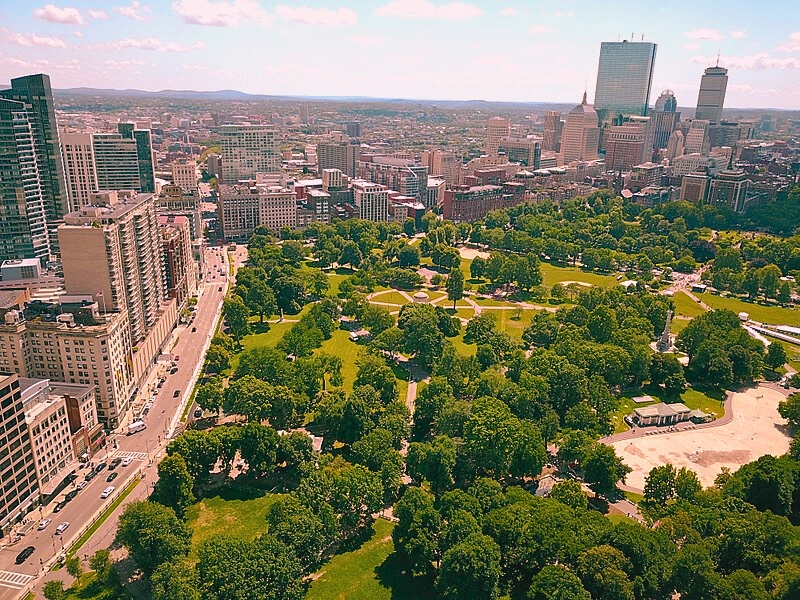
The Boston Common is the oldest public park in the United States, covering 50 acres in the heart of downtown. Bounded by major streets like Tremont, Park, and Beacon, it’s part of Boston’s famous Emerald Necklace of parks.
While it’s a popular gathering place today, its past is filled with hauntings and legends tied to its history of public executions and burials.
The Great Elm, which stood until 1876, served as a notorious hanging tree where many, including pirates, witches, and Native Americans, met their end.
Though the tree is gone, a plaque now marks its former location, giving visitors a chance to stand among the executed in one of the most haunted places in Massachusetts.
Haunted History and Key Events
- Tantamous (The Medicine Man): A Native American leader, Tantamous was hanged on the Great Elm in 1676 during King Philip’s War. His spirit, along with those of other Native Americans executed there, is said to linger near the tree’s former location.
- Ann “Goody” Glover: Accused of witchcraft, Goody Glover was executed in 1688 on the Great Elm after being blamed for cursing children. Visitors report hearing eerie voices near the tree’s site.
- Rachel Wall (The Female Pirate): Hanged on the Great Elm in 1789, Rachel Wall was the last woman executed in Massachusetts.
- The Bodies Dug Up in 1895: Over 1,000 bodies were disturbed during subway construction under Boylston Street. Many of these bodies had been forgotten in old cemeteries. Angry spirits are believed to haunt the area, especially the subway tunnels.
Ghostly Sightings
- The Haunted Subway Tracks: Passengers report hearing moaning and wailing as they ride the subway beneath the Common. Some have seen ghostly figures on the tracks.
- The Redcoat Soldier: A ghostly British soldier in full uniform is often seen on the subway tracks early in the morning, waiting for battle.
- The Burying Grounds: Visitors to the Central Burying Grounds report seeing the spirits of those buried there, including a mysterious girl who has been known to taunt passersby, even taking their belongings.
Longfellow’s Wayside Inn
Sudbury

Located in Sudbury, Massachusetts, Longfellow’s Wayside Inn is rich in history and home to one of its most famous spirits, Jerusha Howe.
Jerusha Howe: The Belle of Sudbury
Jerusha Howe (1797-1842) was known for her beauty and musical talent. Legend says she fell in love with a British man who never returned for her, leaving her heartbroken. Her spirit is said to linger in Room 9, where guests report feeling her presence, hearing unexplained piano music, and even seeing her apparition.
The Haunted Hobgoblin Room
The Hobgoblin Room was once a grand hall but is now a bedroom known for its eerie happenings. Guests have felt cold spots and experienced a heavy, unsettling energy in the room. The room is called the Hobgoblin Room because of reports of strange and mischievous unexplained activity and sightings of a weird figure believed to be a hobgoblin, a type of mischievous spirit in English folklore.
The Secret Drawer Society
The Secret Drawer Society (SDS), started by innkeeper Frank Koppeis in the 1960s, began as a way for children to find hidden drawers in the inn’s furniture. Over time, it evolved into a way for guests to leave notes and share their haunted experiences with Jerusha Howe.
The Omni Parker House Hotel
Boston
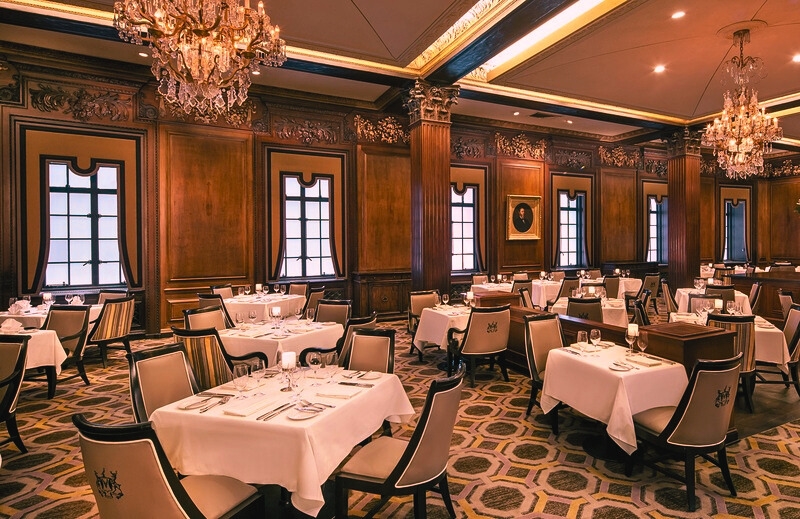
The Omni Parker House Hotel, an iconic landmark in Boston’s historic district since 1855, exudes old-world elegance. Founded by Harvey Parker, the hotel has a rich history of famous guests and strange occurrences.
Hauntings:
- Harvey Parker’s Ghost: The hotel’s founder, Harvey Parker, is often seen on the 10th floor. Guests report seeing a man resembling Parker near room 1078, described as an older man with a mustache who vanishes into thin air. Other guests have heard the eerie creaking of a rocking chair, though no such furniture exists in the hotel.
- Room 1012: One notable encounter involved a mother and daughter staying in room 1012. The daughter awoke to see a man from the 1800s standing at the foot of her bed, only for him to disappear. Later, she recognized the man as Harvey Parker from a portrait hanging in the hotel.
- Room 1040: Guests in room 1040 frequently complain of strange noises, but the room is always found empty upon investigation. Bellmen have reported seeing “orbs” floating down the hallways, adding to the spooky atmosphere.
- The 3rd Floor Ghosts: Charles Dickens, who stayed on the 3rd floor during his visits, is said to have left an impression. Elevators are often mysteriously called to the 3rd floor without anyone waiting. Some guests have also reported the scent of whiskey and cigars in room 303.
- The Bosworth Section: In the oldest part of the hotel, the Bosworth section, a security guard once encountered a shadowy man in a stovepipe hat who disappeared into thin air.
- The Saturday Club: The Omni Parker House was once a favorite haunt of the Saturday Club, a prestigious group of poets and philosophers, including Charles Dickens, Ralph Waldo Emerson, Nathaniel Hawthorne, and Henry Wadsworth Longfellow.
The Colonial Inn
Concord
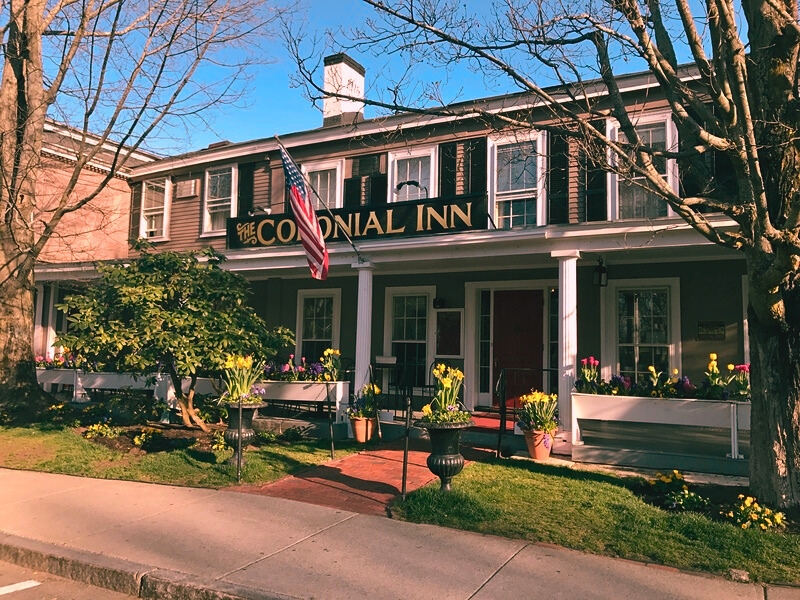
Built before the Revolutionary War, The Colonial Inn has witnessed significant moments in history, including the first battle of the war, where “the shot heard around the world” was fired at Lexington and Concord.
But beyond its war history, the inn is known as one of the most haunted places in Massachusetts.
Room 24 and The Morgue
During the Revolutionary War, the inn’s Room 24 served as a makeshift morgue. Visitors report lights flickering, televisions turning on by themselves, and strange voices.
Some have seen a middle-aged woman believed to be Rosemary, a nurse who has tended to soldiers.
Paranormal Experiences:
- Guests have reported waking up to find their lights or T.V.s turned on without explanation.
- Floating orbs are frequently spotted, and eerie voices echo through the hallways at night.
- Many guests claim to have seen an older woman roaming the halls, believed by many to be the ghost of Rosemary.
Interesting to Note
JoIn 1835, the East House of the Colonial Inn was the primary residence of famous author Henry David Thoreau.
The USS Salem
Quincy

The USS Salem, a post-World War II heavy cruiser, was deployed to Greece in 1953 to provide disaster relief following the Great Kefalonia Earthquake, a tragic event that left hundreds dead and many more injured.
Hauntings:
- The 400 Greek Casualties: After the earthquake, the ship’s morgue temporarily housed around 400 deceased Greek victims. Their spirits are said to haunt the third wardroom. Afterward, the USS Salem earned its eerie nickname, “The Sea Witch.”
- The Burning Man: Believed to be a victim who suffered fatal burns, this haunting is known for his disturbing presence and the smell of ash that accompanies him. He is seen near the ship’s morgue.
- The Ghost Girl of the Halls: A pale, Greek-speaking spirit who is missing part of her face wanders the corridors. Some believe she died during the earthquake.
- The Salty Sea Captain: Amother, haunting, said to be a volunteer during the quake who committed suicide after discovering his wife’s mutilated body. His ghost roams the decks, muttering bitterly and staring into the sea.
- The Cook: A former kitchen aid who likes to keep the kitchen clean, even in the afterlife. Pots and pans are sometimes heard clanging and banging together when no one is around, courtesy of the cook.
King’s Chapel Burying Ground
Boston
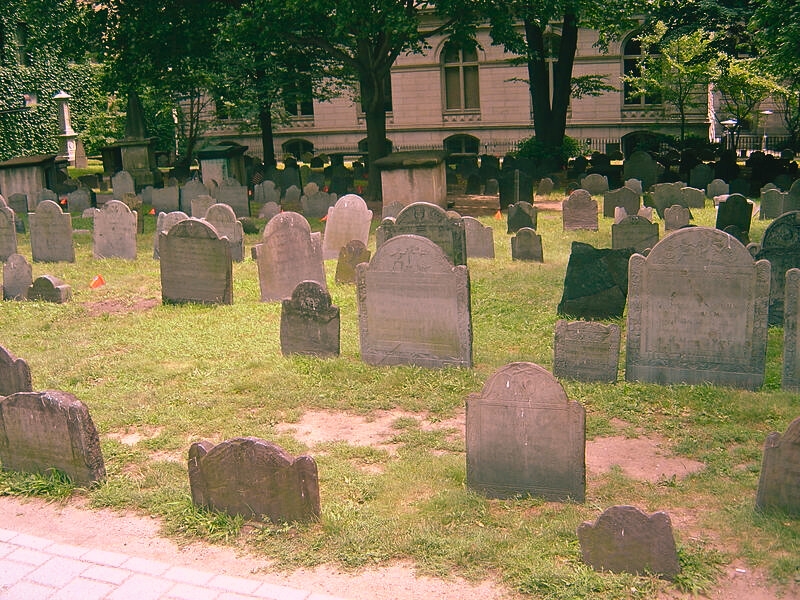
Established in 1630, King’s Chapel Burying Ground is Boston’s oldest cemetery and final resting place for many early settlers of the Massachusetts Bay Colony.
Originally owned by Isaac Johnson, the cemetery was his vegetable garden until his death, and it served as the city’s only burial ground for 30 years. The historic site is one of the most haunted places in Massachusetts.
Notable Headstones and Hauntings
- Joseph Tapping Headstone: Near the entrance stands the haunting gravestone of Joseph Tapping, depicting a skeleton trying to snuff out a candle while Father Time tries to keep it lit. This chilling image reflects the struggle between life and death, making it one of the most iconic and unsettling markers in the cemetery.
- Elizabeth Pain Headstone: This gravestone inspired Nathaniel Hawthorne’s The Scarlet Letter. Though it simply reads, “Here lies the body of Elizabeth Pain,” her life story sparked Hawthorne’s imagination, leading to the creation of his famous character, Hester Prynne.
- The Headless Woman: In the westernmost part of the graveyard, the spirit of a headless black woman is seen. Legend goes that her coffin was too small, and her head was gruesomely sawed off to make her fit.
- Buried Alive: In the early 19th century, stories surfaced about a man being buried alive in King’s Chapel. According to a Chicago Tribune article from 1899, premature burials were not as uncommon as you would hope.
- Captain Kidd: The infamous pirate, Captain Kidd, haunts King’s Chapel. He was hanged for piracy and buried here. Visitors have heard his voice and seen his ghost in full-on pirate gear.
- Orbs and Apparitions: Many visitors see orbs of light and experience strange flashes of light. Some claim their videos mysteriously vanish from their cameras after filming in the cemetery.
Famous Graves
King’s Chapel is the final resting place of notable figures like Mary Chilton, the first European woman to arrive at the Massachusetts Bay Colony, and John Winthrop, the first colony governor. Many Revolutionary War heroes and Puritans also rest here.
Haunt Us
Don’t let your ghost stories go untold. Have you been to any of the most haunted places in Massachusetts? Share your ghost-hunting experiences in the comments below, visit the forums, and become part of our haunted community.