

Coal Dust & Spirits: 12 Most Haunted Places in West Virginia
The most haunted places in West Virginia aren’t hidden in creepy old houses. They’re woven into the very hollers of the Mountain State.
From Civil War battlefields to asylums, West Virginia proves that not every local legend is just tall talk. Maybe it’s the coal dust in the air or the winding roads that seem to lead back in time, but WV is haunted AF.
These are the 12 most haunted places in West Virginia:
Trans-Allegheny Lunatic Asylum
Weston

The Trans-Allegheny Lunatic Asylum is one of the most haunted places in West Virginia and a chilling reminder of how thin the line between care and cruelty is.
Construction began in the 1850s and took nearly 20 years to complete.
When it first opened in the 1860s, the asylum was a progressive facility designed to offer privacy, dignity, and therapeutic activities for those suffering from mental illness. But as decades passed, overcrowding and neglect transformed it into a place of torment. Patients endured brutal conditions, lobotomies, and abuse before the asylum finally closed in 1994.
Among the most famous spirits is Lily, a little girl who never left the asylum. Born there after her mother was admitted following the Civil War, Lily died at nine years old from pneumonia. Guests often leave toys in her room and swear they see them move.
The spirit of a nurse named Elizabeth roams the halls as if still caring for her charges. Another presence, known as Jesse (or James, depending on the storyteller), haunts the bathroom where he died of a heart attack.
The asylum also houses darker forces born of its violent past.
Two sadistic patients once tried to hang another, and when that failed, they crushed his skull beneath a bedpost. Their shadows still drift through the building, draining the energy from rooms and leaving visitors nauseous or weak.
An especially malevolent entity known only as “Slewfoot” stalks the upper floors. In life, he was a killer who murdered people in the upstairs bathroom.
Did you know?
Today, visitors can explore its shadowed halls on ghost tours.
The Greenbrier Ghost Site
Sam Black Church

Few stories in American history are as strange and haunting as that of the Greenbrier Ghost, making this site one of the most haunted places in West Virginia. It all centers around Elva Zona Heaster Shue, whose spirit reportedly returned from the grave to identify her killer and help convict him in court, the only known case in the U.S. where a ghost’s testimony played a role in a murder conviction.
In January 1897, 23-year-old Zona was found dead at her Greenbrier County home. Her husband, Erasmus “Trout” Shue, had sent her on an errand. The local doctor arrived soon after but was quickly dismissed by Erasmus, who insisted there be no further examination.
Zona’s body was dressed in a high-collared gown and buried without clear answers about her death.
Weeks later, her mother, Mary Heaster, began having vivid visions of Zona’s spirit. According to Mary, the ghost revealed that her husband had broken her neck; “squeezed off at the first joint.”
Convinced her daughter was speaking the truth from beyond the grave, Mary demanded an exhumation. A second autopsy confirmed Zona’s neck had been broken, leading to Erasmus Shue’s arrest, trial, and eventual conviction for murder.
Today, a historical marker commemorates this bizarre case just off Interstate 64 near Sam Black Church. Visitors can stop along U.S. Route 60, a few feet south of Exit 156, to read about the Greenbrier Ghost.
Zona’s grave rests nearby at Soule Chapel Cemetery on Farmdale Road, a quarter mile off Old Highway 60 and seven miles south of Rainelle.
The story of Zona Heaster Shue remains a chilling part of West Virginia folklore, a reminder that justice prevails after death.
West Virginia State Penitentiary
Moundsville

Operating from 1866 until 1995, the West Virginia State Penitentiary was one of the most notorious prisons in the country and is now one of the most haunted places in West Virginia.
Built in a Gothic style that resembles a medieval fortress, the penitentiary once held hundreds of dangerous criminals and witnessed countless acts of violence. The prison was also the site of several grim moments in history, such as “Black Friday” on January 17, 1936, when seven inmates were executed in a single day.
The Shadow Man
Perhaps the most well-known spirit within the prison walls is the Shadow Man. Countless visitors have had encounters with this tall, dark figure, described as having glowing eyes and the ability to move through solid walls. Many believe he is the restless spirit of an inmate who died in his cell.
Witnesses say the Shadow Man lurks just beyond sight, watching from behind cell bars or appearing in empty corridors.
The Lady in White
Equally haunting is the Lady in White, a ghostly figure seen in the halls wearing a long white gown.
Her story is tragic.
She was brought to the penitentiary after being accused of murdering her own child and sentenced to life behind bars. Mysteriously, she died soon after her arrival, and many believe her spirit remains.
Visitors report seeing her pacing silently down hallways or standing near barred windows. At times, soft crying or whispered words echo through the empty corridors, believed to be her voice.
The Faceless Man
Among the prison’s most disturbing apparitions is the Faceless Man. With no identifiable facial features, he is a terrifying presence. According to accounts, this spirit is that of an inmate who was savagely beaten to death by fellow prisoners. His faceless form is thought to represent the dehumanization he endured in his final moments.
Witnesses see him peering from cell doors or shadowy corners, and some even feel his cold breath or watch him pass through walls.
Alongside guided tours offered throughout the year, the West Virginia State Penitentiary transforms into a haunted house every October.
Did you know?
Notable inmates included members of Charles Manson’s “family,” Carl Panzram, a man who confessed to murdering 22 people, and Harry Powers, known for killing two widows and three children in his so-called “murder castle.
Lake Shawnee Amusement Park
Rock

Operating from 1926 until about 1988, Lake Shawnee Amusement Park is one of the most haunted places in West Virginia and a site where frontier violence, tragic accidents, and later amusement-park cheer collided.
The parcel that became Lake Shawnee begins before the park, with an 18th-century settlement by Mitchell Clay. The land later became a public attraction when Conley T. Snidow opened the park in 1926.
Over the decades, the park featured a Ferris wheel, a rotating swing ride, a swimming pond, a dance hall, cabins, concession stands, and a racetrack. The park closed after a failed health inspection in the late 1960s.
In the mid-1980s, Gaylord White briefly reopened the park before the grounds fell back into legend.
The 1783 Shawnee skirmish in detail
Long before the park, the land saw violence in the late 1700s. Mitchell Clay and his family lived on the Bluestone River frontier when a raiding party of Shawnee warriors attacked in 1783.
Two children of Mitchell Clay, commonly named Bartley and Tabitha in local records, died during that attack, and a third child was taken captive and burned at Chillicothe.
After the attack, Clay gathered a group of neighboring settlers to pursue the Native American raiding party, hungry for revenge. When they caught up, a gun battle broke out, and several of the Native Americans were killed in the fight.
Clay reportedly recovered the bodies of his murdered children afterward and buried them near the homestead.
A marker memorializes the Clay children’s graves near the lake.
Building the Park
In 1926, Conley Snidow developed the land as a community attraction for Mercer County families, especially coal-mining families nearby.
The park ran for decades but accumulated its own tragedies: at least two drownings in the swimming pond and a child’s death on the swing ride are recorded. Health inspectors closed park operations in the late 1960s, and although an attempt to revive the grounds happened in the 1980s, the site eventually settled into an abandoned unrest.
Haunted Objects
Local guides and many visitors describe repeated, specific phenomena tied to the park’s tragedies. The most often mentioned spirit is the little girl who died on the swings. One swing at the old set is marked with a red ribbon where people leave toys. Witnesses report toys moving on their own and occasional laughter or glimpses of a little kid near that spot. An adjacent swing often holds an owl ornament.
On still days, the owl appears to spin or twitch as if blown by an invisible breeze, and then suddenly goes limp as though someone switched it off.
Another presence is the boy who drowned in the lake. His energy tends to linger near the park entrance and the front lawn, where he might have wanted to be protective.
Near the old ticket booth, a white plastic pinwheel often moves with no breeze. Guides and onlookers have filmed the pinwheel accelerating or slowing on command during tours.
Did you know?
The site is located on private property but offers tours by appointment, including daytime history tours, photo/history tours, overnight stays for investigators, and a Dark Carnival around Halloween.
The Blennerhassett Hotel
Parkersburg
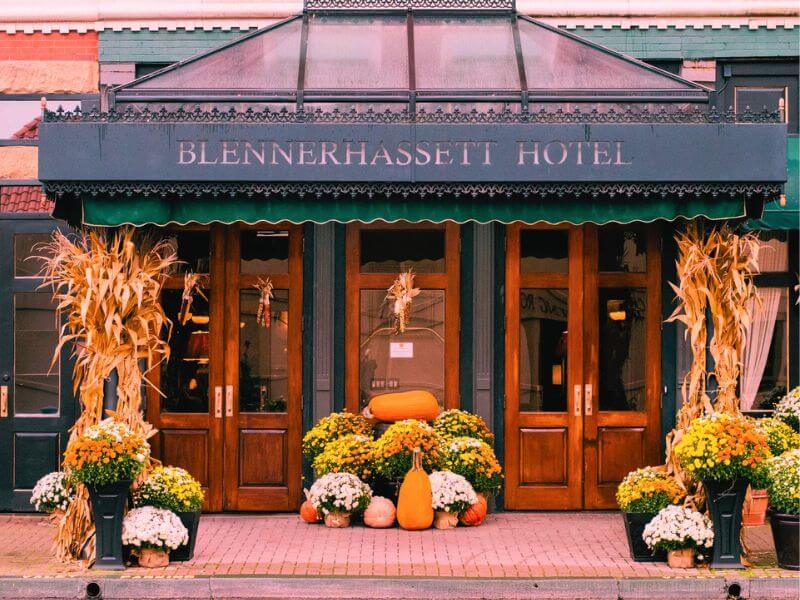
Opened in 1889, the Blennerhassett Hotel has stood for more than a century as one of the most haunted places in West Virginia.
Built in the Queen Anne style, the hotel was added to the National Register of Historic Places in 1982.
Manifestations:
The Stacking Ghost: This entity is obsessed with o, known for stacking papers left scattered across desks.
Once, an employee returned from lunch to find her messy desk perfectly organized, even though no one else had been in the room.
The Woman in White: Dressed in 1920s or 1930s attire, a white fur-trimmed jacket, white skirt, and cap pulled low, she is seen rushing toward the elevator. Once, an employee asked her to hold the door, only to find no one inside. The scent of lavender perfume sometimes appears, and elevators frequently stop on the second floor with no explanation.
Little Newspaper Boy: Dressed in period clothes and carrying a newspaper bag, he’s seen near the kitchen or old break room. Employees feel tugs on their clothing before turning to see the boy staring up at them, seeking attention as he did in life.
The Smoking Gentleman: Most often recognized by the scent of his cigar before he’s seen. Witnesses describe a man in his 60s, wearing a three-piece gray suit, often on the second and third floors. Many believe this is William Chancellor, the hotel’s original owner, who died in 1909 and may still keep watch over his creation.
The Sea Captain: Spotted reflected in the mirrors of the lobby, restaurant, or bar. Some believe he is a sailor who once visited the hotel, while others think he resembles Harman Blennerhassett, the aristocrat for whom the hotel is named.
Man in a White Tuxedo: Appears in mirrors, often carrying a brass-handled walking stick and sporting flowing white hair, feet never touching the floor.
The Balcony: Blood-curdling screams are heard through the library and ballroom. One theory ties these screams to a tragic accident decades ago when a woman was killed instantly by a runaway truck as she entered the bank that once shared a doorway with the library.
The ballrooms are notorious for activity. Place settings are mysteriously rearranged, items vanish and reappear, and once, during a setup, a microphone let out a cheerful “Howdy, fellas!” despite the room being empty.
Kissing Bandit: Some visitors have woken to the sensation of soft kisses across their faces. The light, childlike touches vanish the moment the startled guests sit up. Child spirits are also known to giggle, spin toilet paper rolls, leave footprints on beds, and sing Jingle Bells over the hotel’s holiday music.
Four O’Clock Knocker: On certain days, precisely at 4:00 a.m., staff hear three sharp knocks on a door near the Starbucks area. No one is ever there when they open it.
The Wake Up Bellboy: A teenage boy in a blue uniform with a gold rope has been seen smiling down at sleeping guests before vanishing.
Poltergeist activity: Chairs are overturned, antique books are scattered, and in one bizarre incident, an ottoman’s fabric was stretched upward into a tent-like shape. Some believe these disturbances are caused by residual human energy, while others think they’re the work of non-human entities.
Harpers Ferry Ghosts
Harpers Ferry

Harpers Ferry is one of the most haunted places in West Virginia, and its dark history stretches far beyond ghost stories.
Contrary to the sound of the name, it isn’t actually a ferry. It’s a historic town named after a ferry owner.
This town in the state’s Eastern Panhandle has witnessed centuries of violence, tragedy, and transformation, and the scars of its past show in the streets, churches, and historic homes that line its cobblestone roads.
Founded in the late 1700s, Harpers Ferry grew quickly thanks to its strategic location where the Shenandoah and Potomac rivers meet. St. Peter’s Roman Catholic Church, the oldest church in the town, has stood through floods, fires, war, and unrest.
Today, visitors still report seeing the ghost of a devoted priest praying for his congregation inside.
John Brown, Slavery, and a Nation’s Reckoning
The story of Harpers Ferry cannot be told without understanding the brutality of slavery and the man who tried to end it here.
Abolitionist John Brown, determined to end slavery by any means necessary, chose Harpers Ferry as the site for his boldest act. In 1859, he and his men launched an armed raid on the federal arsenal in the town.
Brown believed that by seizing weapons, he could inspire an uprising of enslaved people.
But the plan failed.
Federal troops, led by Robert E. Lee, stormed the town, killing many and capturing Brown himself.
He was later hanged for treason, but his raid lit a spark that helped ignite the Civil War.
Harpers Ferry continued to suffer during the conflict, changing hands between Union and Confederate forces.
Hauntings of Harpers Ferry
- The Priest at St. Peter’s Church: The ghost of a former priest is said to still pray inside the oldest church in Harpers Ferry. Visitors have seen him kneeling in devotion, a quiet guardian of a town long scarred by violence.
- The National Park Service Guest House: A woman in a long, gray, hooded dress and an eight-year-old girl appeared on the staircase, vanishing before startled witnesses. A glaring man in a brocade vest and top hat often stands menacingly at the end of the hall.
- The Child: Residents have reported sobs coming from closets and rooms where no one is present. A discovered diary revealed a likely cause: a baby once died when a chimney collapsed during a Civil War battle.
- Laborers: Witnesses have seen a man in 19th-century work clothes carrying a dead body through a hallway before disappearing.
- Drummer Boy: Along High Street, the sounds of fife and drum accompany a ghostly marching army. The spirit of a young drummer boy, thrown from a window by a Union soldier, still cries out for his mother.
- The Kennedy Farmhouse: Five miles outside town, John Brown’s old headquarters still carries his presence. Footsteps echo in the attic where he and his men slept, and visitors hear snoring, murmurs, and pacing. One psychic claimed to speak with Brown, who was glad the building had been restored.
- The Burned Girl: The spirit of a young girl who perished in a fire in 1830 is heard screaming for help.
- Father Costello: On the hill above town, the ghost of Father Costello prays for his congregation.
Harpers Ferry remains one of the most haunted places in West Virginia, and today, you can walk its streets, visit historic buildings, and join ghost tours.
Flinderation Tunnel
Salem

Flinderation Tunnel, also known as Brandy Gap Tunnel #2, is one of the most haunted places in West Virginia and a stop along the North Bend Rail Trail in Harrison County.
Built in 1854 as part of the B&O Railroad line, the tunnel was a vital link for the Northwestern Virginia Railroad, which was then abandoned in 1985.
The tunnel’s haunted history began almost immediately during its construction. Workers faced dangerous conditions, and accidents were common.
Over the decades, stories of death and supernatural occurrences made this tunnel famous.
Haunted History
Death During Construction (1853): On January 15, 1853, a worker named Hanley was killed when a mound of earth collapsed on him inside the tunnel. Two others were seriously injured. Hanely’s body was transported to Fairmont for burial.
- Train Accident: Workers were caught off guard by an oncoming train. One was unable to reach the safety alcove and was killed instantly. Another was cut in half, and a third was dragged 75 feet beneath the train, causing it to derail.
- Phantom Train: Visitors have heard the rumble of a train roaring through the tunnel, decades after the line was shut down.
- Lights: Strange glowing orbs float through the darkness, following those who dare to walk inside.
- Unexplained Sounds: Witnesses describe hearing metal scraping against metal, heavy footsteps, disembodied growls, and the sound of children laughing.
- Mist: A cold, ghostly fog sometimes forms in the tunnel, trailing behind visitors before vanishing without a trace.
Droop Mountain Battlefield
Hillsboro

Droop Mountain Battlefield is one of the most haunted places in West Virginia and the site of the last major Civil War battle fought in the state.
On November 6, 1863, Union forces under Brigadier General William W. Averell clashed with Confederate troops led by General John Echols in a brutal fight. The Union victory ended any serious Confederate attempts to regain control of the region.
The battle left at least 78 men dead (45 Union soldiers and 33 Confederate soldiers).
The site is now a peaceful state park with sweeping mountain views from the iconic Droop Mountain Tower, but visitors say the battlefield is far from quiet.
Many have seen ghostly soldiers dressed in Civil War uniforms marching across the fields or standing guard near the trees. These apparitions often vanish the moment anyone approaches.
The sounds of battle still seem to haunt the grounds. Guests have heard gunfire crack through the air, the deep booms of cannons, and the metallic clash of swords. Some hear the thunder of galloping horses and sightings of a headless Confederate soldier wandering the hills.
Another manifestation is often seen slumped against a tree, eternally asleep, where he likely died more than 150 years ago.
Droop Mountain Battlefield State Park still welcomes visitors to explore its scenic trails, monuments, and historic landmarks.
22 Mine Road
Logan

High in the hills of Logan County, 22 Mine Road is the site of one of West Virginia’s most notorious unsolved murders.
On June 21, 1932, the body of 31-year-old Mamie Thurman, a police officer’s wife known for her lively spirit and church involvement, was found shot and stabbed in a ditch along the isolated mountain road.
Behind her respectable image, Mamie had been involved in a scandalous affair with her landlord, banker Harry Robertson. Although Robertson’s handyman was convicted of the crime, many believe the powerful banker himself was responsible.
Even stranger, no burial records for Mamie have ever been found.
Today, her restless ghost is said to wander the roadside, appearing as a dark-haired woman searching for justice.
Appalachian Trail

The Appalachian Trail clips West Virginia at Harpers Ferry, home to the Appalachian Trail Conservancy. Hikers pass battlefields, rail lines, and historic streets where people still trade tales of strange sightings, tragedies, and unsolved cases.
These are just a few of the most haunted places on the trail:
- Hog Alley: During John Brown’s 1859 raid, raider Dangerfield Newby was killed, and his body was dragged to what locals call Hog Alley. Guides and writers say people still report seeing a figure in black with a gashed neck walking the narrow lane.
- “Screaming Jenny” by the B&O tracks (Harpers Ferry): Folklore tells of a woman who caught fire in a trackside shed and stumbled onto the rails, where a train struck her. Train crews and passengers have long repeated claims of a flaming figure and panicked cries near the same spot.
- Silver Run Tunnel, North Bend Rail Trail: Locals say a woman in white haunts the tunnel’s damp interior. At night, hikers and cyclists report hearing footsteps echo, wisps of fog, and a sense of being watched as they pass through the 1,376-foot tunnel.
Did you know?
The Appalachian Trail is over 2,190 miles across 14 states, making it the longest continuous hiking-only path in the world.
The Old Hospital on College Hill
Williamson
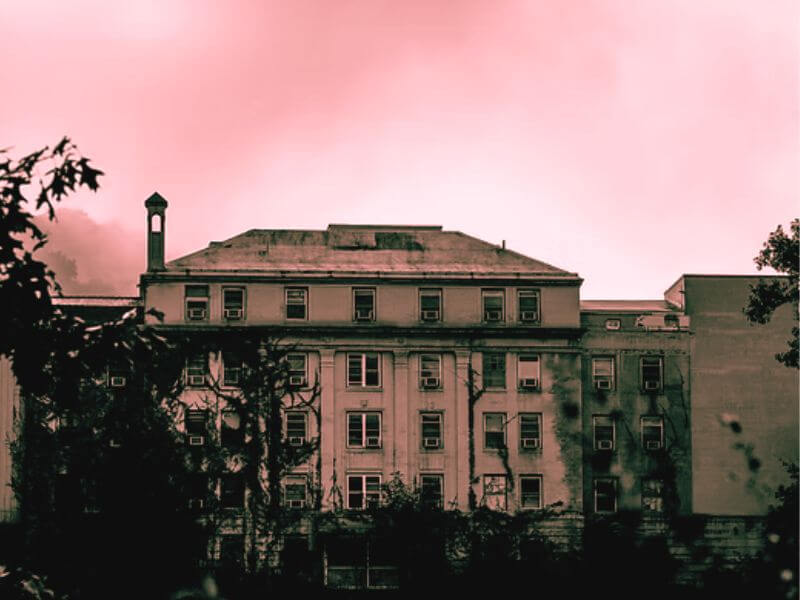
Overlooking the small town of Williamson, the Old Hospital on College Hill has stood for nearly a century.
The abandoned hospital is infamous for unexplained lights, shadowy figures in windows, and ghostly footsteps echoing through its empty halls.
Locals say a nurse who died during her shift still makes her rounds, once even convincing a new mother she could leave, though no living nurse had spoken to her.
Renovation workers have seen full-bodied apparitions in the corridors, and visitors in the basement have heard a desperate voice whisper, “Help me.” The elevator sometimes stops on sealed floors, as if summoned by unseen hands.
With its dark energy and decades of tragedy, the Old Hospital on College Hill has earned its reputation as one of the most haunted places in West Virginia.
Today, the Old Hospital on College Hill welcomes curious visitors through guided historical and paranormal tours.
Haunt Us
Don’t let your ghost stories go untold. Have you visited any of West Virginia’s most haunted places? Share your ghost-hunting experiences in the comments below, visit the forums, and become part of our haunted community.


