

Haunted El Campo Santo Cemetery: Ghosts Under the Pavement
Is El Campo Santo Cemetery haunted?
People who have visited the cemetery know the answer: yep.
Established in 1849, El Campo Santo is the second oldest cemetery in California, located in Old Town San Diego, and has become well-known for its haunted happenings.
The spirits of those buried there, whose graves were disturbed when the city expanded, are pissed.
Here, we explore what makes El Campo Santo Cemetery haunted via the records, burials, and creepy photos that tell its story:
Here is your guide to El Campo Santo Cemetery:
El Campo Santo is a Special Place
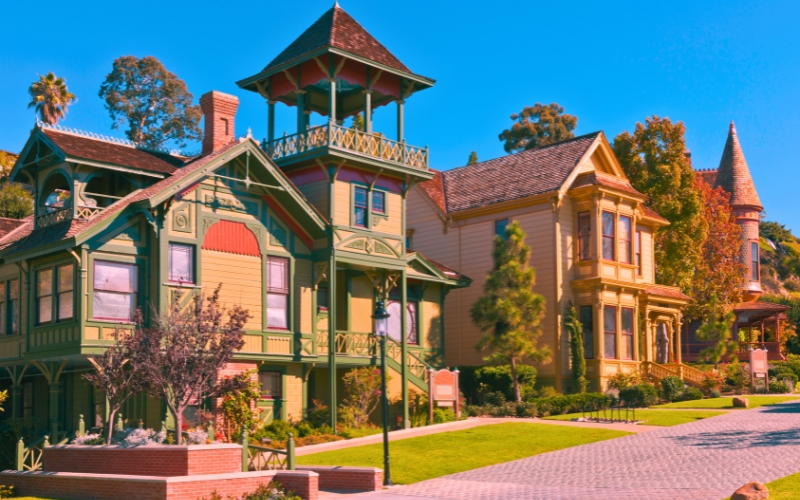
This tiny little graveyard is bypassed by tourists on their way to the nearby Whaley House or one of the many Cali-Mex restaurants along the busy San Diego Avenue.
The place carries an Old Western goth vibe. Wrought iron fences and unembellished white crosses look almost colorful against the dusty red dirt ground.
The cemetery is hot and defended against the sun by one brave tree. A short stone wall surrounds El Campo, but that isn’t the boundary; more graves lay forgotten under the street and sidewalk.
So, is El Campo Santo Cemetery haunted? Many visitors and locals are convinced that, yes, it is.
The disruption of the graves during San Diego’s expansion is thought to have angered the spirits. Whether or not you believe in ghosts, the history and atmosphere of El Campo Santo Cemetery make it a fascinating place to visit.
The Expansion of the Cemetery

One of the reasons people believe El Campo Santo Cemetery is haunted is related to its ugly history of expansion.
As the city of San Diego grew, most of the cemetery was sacrificed in the name of progress. A horse-drawn streetcar line was added right through the cemetery, which later became San Diego Avenue.
Graves were disturbed, and while many bodies were relocated, some were left behind, their final resting places forgotten beneath the concrete.
The removal of graves is blamed for the hauntings in the cemetery. The streetcar line has since been removed, and now the bodies are paved under San Diego Avenue. In 1993, the city used radar to determine the exact location of bodies and installed plaques to mark their approximate location.
Walking down San Diego Ave, you’ll see small, circular metal plaques throughout the street and sidewalk that simply say ‘grave site.’ Sadly, that is all that remains of these once-living human beings.
This shitty treatment is part of what makes El Campo Santo Cemetery haunted. Locals say that anyone who parks directly over one of these graves will later have difficulty starting their car or have their car alarm sound.
El Campo Santo Cemetery Records
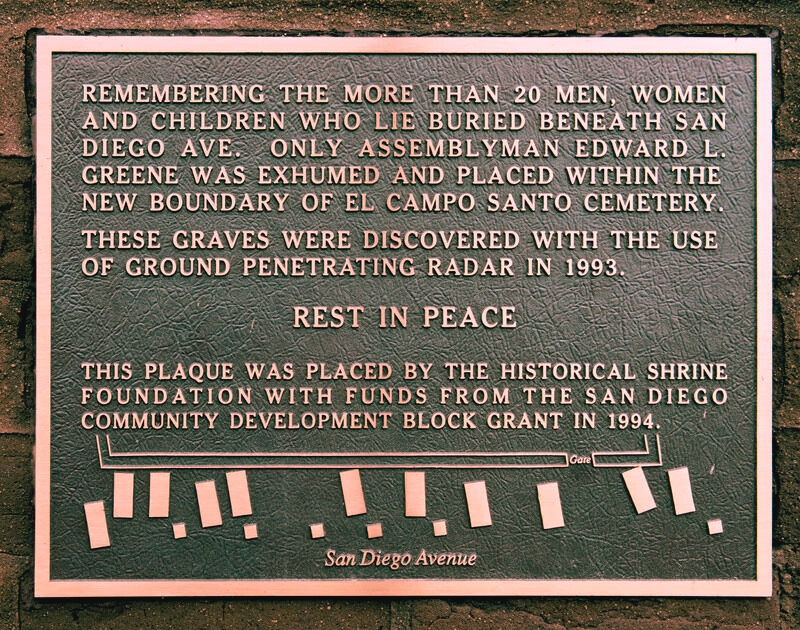
El Campo Santo Cemetery holds the remains of over 450 people, many of whom were early San Diego settlers.
However, records show that the cemetery has been heavily disrespected. In the 1880s, a streetcar line was built over part of the cemetery, and later, a road and sidewalk were built directly on top of unmarked graves!
This disrespect of the final resting place of so many souls is one major reason why El Campo Santo Cemetery is haunted.
Although some records have been lost over time, a number of burial documents are available to the public. You can access more information about the individuals buried there through online archives or local historical societies that have tried to preserve what they can of these important records.
Burials at El Campo Santo Cemetery
The haunted El Campo Santo Cemetery has seen many burials over the years, from VIPS to everyday settlers.
Some of the most notable headstones you’ll find include:
Juan Mendoza
Juan Mendoza was shot in the back by local landowner Cave Johnson Couts, who claimed he only shot Mendoza because he threatened his life. Shooting someone in the back violates the legendary Code of the West, which prohibited both shooting an unarmed man and shooting a man in the back. In court, Couts was found not guilty despite shooting Mendoza in broad daylight in front of witnesses.
Yankee Jim Robinson
You’ve probably heard this name around Old Town San Diego before.
Convicted of grand theft and executed where the Whaley House would later be built, Yankee Jim Robinson died a slow, painful death. Because the rope used to hang him was slightly too long, he strangled rather than hung, which took between 20-40 minutes. Robinson’s restless spirit still haunts the nearby Whaley House.
Antonio Garra
Today, he is a symbol of indigenous resistance.
In 1852, Cupeño tribal chief Antonio Garra was marched with his hands tied to a newly dug grave. Gaara led a Native American uprising against the government, which was treating them unfairly and stealing their land.
The Catholic priest at his side urged him to pray for his soul as they pushed him along. He repeatedly declined, and observers noted that Garra, who was fluent in 5 languages, spoke better Latin than the priest. On his knees in front of his own grave, he was asked one last time to repent.
Garra’s last words were:
“Gentlemen, I ask your pardon for all of my offenses and accept yours in return.”
Moments later, he was executed by a squad of 12 riflemen. Today, Gaara is remembered as a symbol of indigenous resistance.
Juan María Marrón and his Wife, Isabel Marrón
A prominent Californio figure and early settler of San Diego. He was one of the first landowners in the region and was basically well-known for being rich.
Juan Antonio Aguirre
Another important burial at El Campo Santo, Juan was a wealthy rancher and prominent businessman who built the now iconic Casa de Aguirre in 1853, one of the first houses in San Diego.
Anita Gillis
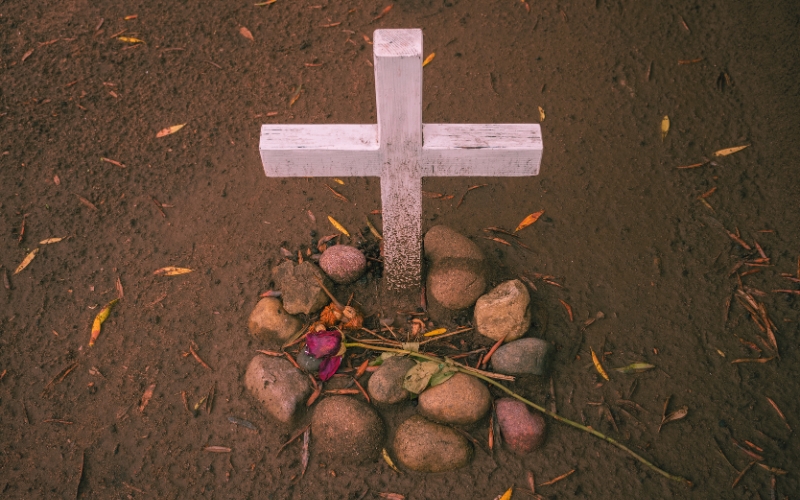
One of the most solemn spots in the cemetery is a simple white cross that reads “Anita Gilles A Little Girl.” On the ground, bricks are laid in a cross, and visits cover it with coins, flowers, butterflies, and other things that might enchant a child.
Anita was a childhood friend of Lilian Whaley of San Diegos’ well-known Whaley family, who died from scarlet fever in 1873. She was one of 3 children of Constable George Gillis and his wife Guadalupe, to pass away in that year, likely from scarlet fever. The 33 Gillis children are presumably buried right to one another, though Anita is the only one marked “Gillis.”
However, even that may not be where she is actually buried. Of the roughly 300 people buried in El Campo Santo, most are in unmarked graves. Like other famous graves in El Campo Santo, such as Antonio Garra and Yankee Jim Robinson, Anita’s grave marker is more approximate than exact.
Anita is known because Lilian Whaley wrote about her funeral procession in her diary during her adult years.
“I remember the funeral procession of little Anita Gillis as it would across the Plaza on its way to the old church. The child lay in a tiny white coffin, which rested on a small white table. The cover was off, and the coffin and table were filled with flowers. Six little girls dressed in white with wreaths on their heads carried the table…
She was carried to the church…A simple, solemn mass was said. She was taken to the old cemetery nearby and buried, and a simple white wooden cross bearing her name, etc, was erected at the head of her grave.”
— Tales from California’s Oldest Town by Lilian Whaley
Interesting Theory
Lillian Whaley likely caught scarlet fever from Anita. She passed this to the entire Whaley family, killing Thomas Whaley Jr., child of Thomas and Anna Whaley, in 1858 when he was just 18 months old.
Mary “Mamie” Stone
A young girl who died at a young age, her grave has become one of the most visited spots in the cemetery. Sadly, how she died was lost to history.
Check out the Old Town San Diego State Historic Park website for a detailed list of burials and additional records.
Hauntings at El Campo Santo Cemetery
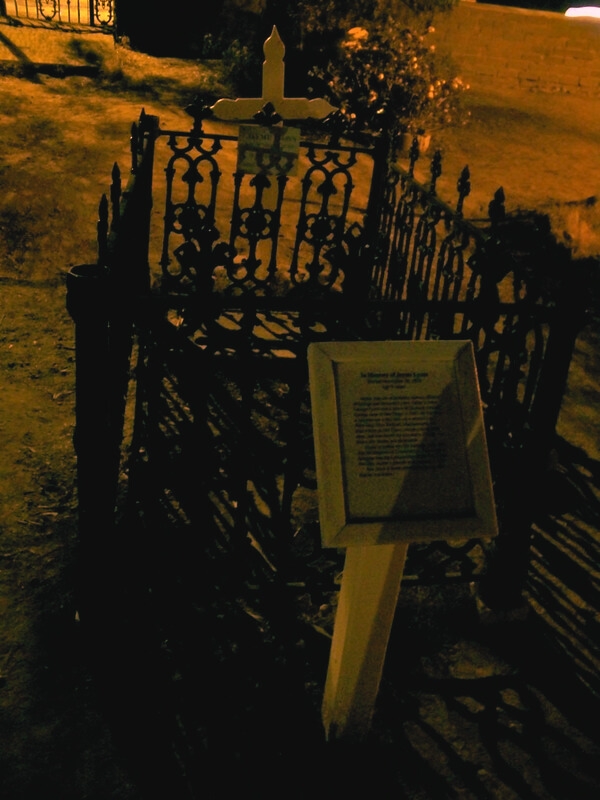
These are the most commonly reported manifestations at El Campo Santo:
- Yankee Jim Robinson: The ghost of Yankee Jim Robinson has been seen in period clothing, bringing with him a feeling of misery.
- Other apparitions, also dressed in period clothing, have been seen above the graves. Freezing cold spots and floating orbs, flashes of light, and shadowy figures have also been seen, especially at sunset.
- Businesses on San Diego Avenue: Regular power outages occur without explanation, and alarm systems, appliances, and lights will go off randomly, lights randomly.
- Artic Cold Spots: Feeling chills or cold spots in haunted places is pretty common. However, those who have experienced them at El Campo say that it’s like walking into a freezer. This is Southern California—it never never gets cold cold, so this is a big deal.
- Poltergeists: The cemetery staff, who dress up in period costumes, are easy to mistake for 19th-century ghosts. Other times, an upper torso in period clothing is seen floating through the graves.
Haunt Us
Don’t let your ghost stories go untold. Have you been to the El Campo Santo Cemetery or other haunted places in San Diego? Share your ghost-hunting experiences in the comments below, visit the forums, and become part of our haunted community.
Get the San Diego Ghost Hunting Itinerary


